Friday, February 10, 2012

Honor Roll – Pre and Desert Storm Era

Well, I'm coming to the end of the Veteran Honor Roll for 2011. I'm ending with myself. I served in the Wisconsin Army National Guard from 1986 – 1992, my unit was the 132nd Support Battalion HHC company based in Madison Wisconsin. I achieved the rank of Staff Sargent or an E6. For those of you not familiar with ranks in the army, an E1 is the first rank; private, an E6 is a n NCO (Non-commissioned Officer). In civilian life that would be like mid management. I was in charge of six to seven soldiers in my section. Believe it or not I couldn't find a picture of myself in uniform – maybe I'll find one in the future. Like my brother and cousin, I joined for economic and education opportunities. Unlike them, I had already graduated from technical school with my AA in data processing, this enabled me to go in at as a private first class and MOS qualified as a 74F (computer programmer/analyst) – which meant I didn't attend AIT (advanced individual training). I chose the Guard, because I didn't want to go into the military full time, and like that the Guard serves both state and nation in times of emergency. I admit, when I first went into the military, I did it for the money, then sometime during basic training, my thoughts and attitude changed. As corny as it sounds; I was proud to serve my country – to do more then the average person would. I also changed personally. I would describe myself before basic training as a painfully shy person.
Basic training, hmmm, how to explain basic to those of you who never when through it. Basic training can be described as Dante's Hell. There are 3 phases to the army boot camp. The first phase is “Red” this is where you meet your Drill Sergeant. Drill Sergeants are a different species, they love to yell at you and they control every part of your life. Their favorite activities are putting you and the rest of your platoon, or any combination into “the front leaning rest” ( the starting position for push-ups while you stand) or doing push-ups. They love saying “DROP AND GIVE ME 20!”
The second phase is “White”. During this phase you go out to the rifle ranges and the grenade ranges. As a side note M16's are OK, but grenades ARE FUN! By now you've been out in the field, 2-3 nights in a shelter half. A shelter half is half of a “pup tent” you pair up with someone else put your halves together and that's your tent, there is only room for your sleeping bags, your backpack is your pillow. While in the field you will be introduced to the MRE – meals-ready-to-eat. It's cold tasteless and pack with salt. There are one or two that aren't too bad. I liked the beef stroganoff and ham with cheese. Two other parts of the second phase are self-defense and the obstacle course. You also start to get a little freedom, this for me meant that we had some time at night that didn't have a Drill telling us what to do. The last phase is “Blue” . This is the most challenging because you have to pass two tests – the PT (physical training) and a basic soldiering test where they test you on what you've learned during the first two phases. You also get to go on long march, I think ours was 10 miles. One of the last challenges is the night patrol with live fire.
After going through basic and moving up the ranks to E6, I became more confident, assertive, and in control of my shyness. In short, a stronger person. I think the real turning point for me was attending Basic Non-Commissioned Officers Course (BNCOC). When my unit sent me to Camp Ashland, I thought it was just more army training, nothing more. When I arrived at Camp Ashland, they gathered us in the commons and did the look to your right, now look to your left; at least one of these people won't be graduating. They broke the class of about sixty-six soldiers into six classes of eleven. In my group two soldiers flunked out at the end of the first test. I got my eyes opened, I could flunk-out, fail, I couldn't go back to my unit a failure, that wasn't an option. So, right at that moment I decided I was graduating.

Saturday, January 14, 2012

Honor Roll – Vietnam

 This honor roll involves 3 relatives – my brother, a cousin and my brother-in-law's cousin.

The first one I'll talk about is my brother. He enlisted in the US Air Force towards the end of the Vietnam war. He enlisted because employment and job opportunities were not what he was looking for. The Air Force offered both an education and a beginning. After finishing basic training in Lackland AFB, San Antonio TX. His AIT (advanced individual training) was at Keesler Air Force base in Mississippi, he was assigned to Ellsworth Air Force Base where he did his full tour of duty. His MOS or AFSC was 328X3 -Electronic Warfare Systems. He achieved the 7th level of his AFS and was considered either a technician or specialist. He was on world deployment status the last year and half of his enlistment, but was not sent anywhere. The jobs performed by 7-skill level airmen are primary that of supervisory and managerial and reflect a decline in time spent performing technical tasks. A Electronic Warfare Systems Specialists job includes: installing, maintaining, and repairing avionic electronic warfare (EW) equipment, intercept and analysis equipment, and special purpose support equipment. Additionally, 7-skill level technicians are responsible for inspecting, troubleshooting, overhauling, and modifying EW and electronic intercept and analysis equipment. He left the air force as an E-5 or staff sargent, he was dual qualified for the flight line and shop, during his last year and a half he was a shop shift supervisor and also a flight line shift supervisor.

My Cousin enlisted in the marines when he was 18 years old. He joined for about the same reasons as my brother – wasn't ready for college and his job was eliminated where he worked. They moved him into a job that was boring, lower pay and it became obvious to my cousin that he didn't want to do that the rest of his life. Also, the bar scene was becoming a regular part of his life and he didn't like it – change was needed.
So the next six years were spend as a marine., During this time he also got married, and the two of them went to his duty station in Japan. After his 6 year enlistment, he knew that 6 years was enough time as a marine, but didn't want to throw away the active duty time. The marine reserves was not a good option, so the Air National Guard it was. With his G.I. Bill benefits he attended school, and worked as a electronics technician. Due to the hiring freezes in the Federal government and implementation of the AGR (Active Guard/Reserve) in the late 70's and early 80's, my cousin found a job as a full time in the Wisconsin Air Guard at Truax Field. From this job as the deputy base engineer at Truax and as a second lieutenant, he continued to get promotions and different AFSC's, or Air Force Specialty Codes.
, which lead to positions at Volk Field and eventually the job of the Chief of the Asset Management Division at Andrews in Maryland along with becoming a full colonel, he happily retired from his military career, as he said – five years in D.C. is enough.


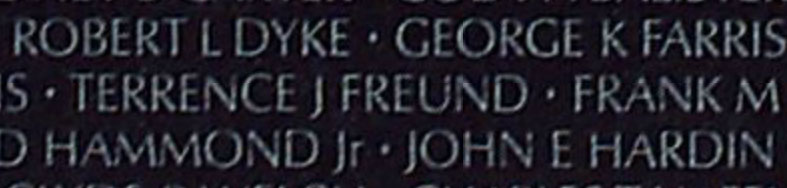
Last but not least, is Terry Freund.  I don't have a picture of Terry yet, this is off of the Veitnam Memorial Wall.  Radioman Second Class Terry Freund was the first cousin of my brother-in-law. Terry served on a Patrol Boat River (PBR - 40) in Vietnam. He was killed in action on 26 October 1966 in Phong Dinh, South Vietnam. He was just twenty-four years old. As far as I know he has been the only family member killed while serving his country. He was a hero in every sense of the word Terry was a “River Rat”. The mission of the Patrol BR or River Rats was to patrol Vietnam’s in shore waterways, inspect suspicious craft, and enforce curfews. Just 31 feet in length, the PBR was fiberglass-hulled boat that could achieve speeds in excess of 30 knots, but offered little protection to their four-man crews. PBR's were armed with machine guns, B-40 rockets, and recoil-less rifles. The Viet Cong had boat-hunting teams that regularly attacked PBRs on the narrower rivers and canals of the Mekong Delta. On 26 October 1966, one of these teams ambushed the PBR that Terry was on. A crewman on the boat observed a 20-foot-long sampan coming out of a canal with three Viet Cong aboard, Terry was manning the forward .50 caliber guns at the time. When hailed, the sampan refused to come alongside, and Terry's boat and a PBR 34 gave chase. After a couple of warning shots were fired, the PBRs opened up on the sampan as it beached, setting the craft on fire. The three men leapt from the sampan and dove into some underbrush as other Viet Cong in foxholes along the beach returned fire. From the articles I found Terry was the first on his boat to return fire, after reloading several times and being fatally wounded himself, Terry fought until he couldn't anymore. At least one account credits him with saving his boat and crewmen. Radioman Freund received the Navy Cross and Purple Heart for his actions.


Wednesday, December 21, 2011

Christmas Traditions

We all have memories of Christmas that are special just to us. These are a few of mine.
I always knew the Christmas season had started when Mom broke out her Burl Ives Christmas albums. She'd play these when we were decorating the tree or when she'd make the Christmas cookies with us (mostly my sister and I) helping her.
We were raised Catholic so every Christmas Eve, when we were little, after dinner, Mom would make us take a nap and then wake us up in order to go to midnight mass. Most of the time all six of us would go but sometimes Dad would stay home. Mom would say he was too tired from working to go with us. When we'd come home from mass and go past the Christmas tree, would you believe it --- Santa came when we were at church! But, Dad was tired and was in bed so we'd have to wait until morning to open our treasures.
Another Christmas tradition for as long as I can remember, after opening Santa's gifts we would take a family portrait. This one I think was taken about 1966. For those who say I never post a picture of myself, I'm the blonde.

Even now when I hear Burl Ives' singing “A Holly Jolly Christmas” I can smell Mom's cookies and feel the excitement of Christmas.

Wednesday, December 14, 2011

Korean Honor Roll


The next stop in the Honor Roll is the Korean Conflict and my Dad.
Jim served in the US Army. He was inducted on Oct 30, 1952 and was discharged Aug 25, 1954 at Ft Sheridan IL. He served over seas in Korea for 1 year and 4 months. While in the army he was awarded the National Defense Service Medal, United Nations Service Metal and the Purple Heart for Pyrone wounds he received on 14 July 1953. He was promoted to corporal (+) on April 16, 1954 and previous to discharge he was promoted to Sargent First Class. This is the basic story of his time in Korea. Here's some of what I've learned since gathering information for these posts. I started my search on the Korean War Project Site, looking for information on my Dad's injuries. I found that, plus a bonus find, one of my Dad's army buddies, “Frenchie”. Frenchie has been a great find, he's filled in a lot holes. One of the more interesting things, was finding out my Dad's group was hit by “friendly fire”. They lost three men and all of their possessions. Frenchie has told me that the 8219TH artillery was what they called a “Bastard Outfit” – “Just a bunch of Nomads wandering all over Korea scrounging for meals”. From what Dad told us, his unit was basically forward observers, Frenchie explained it like this: “Three crews went out every day (one in reserve) to different locations all over Korea depending on what Artillery Unit (U.S or Korean) had to be moved to a new location. We were told the night before what area we would be working in. The Metro Section would tell us what three mountains we were to climb and set up our equipment. This is what they called “Triangulation” so the Artillery Units would know the height of the mountains and distance to their targets. It had to be perfect or it could mean missing a target by a mile or so.” Several of Dad's friends from Korea, remained friends for life, Frenchie, Bill Borman (who one of my brothers were named after) and Harry Berth (who, along with his wife were my godparents).

In Memory
Pvt Rodney Forrest Graff, Pvt John J Jurmu, Pvt Robert G. Wight
(KIA 14 July 1953)

Thursday, December 1, 2011

Honor Roll - WWII

The next people in my Honor Roll are all distant cousins, who deserve to be mentioned. It may seem a little odd, because two are American with German descendants (close family members) and the third is German, all three served honorably during WWII. You could call it my family's civil war.


Joseph Ahles – November 6, 1908 – Feb 15, 2011. Joe was inducted on October 7, 1942 for the duration of the war plus six months. At the time of his induction Joe was employed with J.P Seeburg; a manufacturer of jukeboxes. J.P. Seeburg promised Joe a job upon his return from his time in service. Joe's MOS (military occupational specialty) was forward observer and radio man, (his radio was mounted on a half-track). He was an expert with the light machine gun and a sharpshooter with his carbine. Joe was also the oldest member of his unit – the 7th Army 12th Armored Division 494th Field Artillery C Battery. The 7th Army was attached to Patton's 3rd Army and was an instrumental spearhead for Patton's march through France to the Rhine River. Joe earned the following citations: American Campaign Metal, European, African and Middle East Theater Campaign metal with three bronze stars (for Rhineland, Ardennes-Alsace and central Europe). He also received the World War II victory and Good Conduct metals.
This photograph that my Grandma had of Joe was taken in Aalen, Germany 1945. When Joe finished his tour in Germany and discharged from the army, J.P. Seeburg kept their promise and had a job waiting for him on his return.

Joesf Beck – March 15, 1922 – February 28, 2007
I learned of Joesf through my German cousin who found me just last year. I don't know a lot about Joesf yet, but this is what I've learned so far. This photograph was Joesf's military passport taken in 1941 when he first entered the military. The information I have on him came from my cousin's Grandma. Joesf entered the army at the age of 19. His stations were: Landsberg am Lech and Mittenwald (both in Germany) Then Russia, where he barely escaped the divisions, which were all killed. Joesf's wife talked about a kind of belt that closed and the ones in that belt all died. Then Joesf went to Greece, where he got malaria,and finally,many Eastern block countries, like Bulgaria and Serbia. While serving in Serbia during 1945, he was taken into captivity, and was not released until 1949, at the age of 27 years.

Bud (Jack Jr) Burger March 10, 1922 – September 1, 1981.
Bud was married June 22,1942 and inducted February 20, 1943 and was discharged in February 1946. Jack was in the dental corps during his time in the army. He spend his time in the service states side, his two stations were in Texas and at Fitzsimons Army Hospital, Aurora, Colorado; it was one of the Army's premier medical training centers and used very heavily during World War II to treat returning casualties. Bud didn't stay working in the dental field when he left the army, he went on to be a restauranteur in the Milwaukee area. Like a lot of veterans Bud didn't talk much about his time in the service.

Wednesday, November 16, 2011

HONOR ROLL


Ludwig Adolf Wilhelm Freiherr von Lützow

The first I heard of Ludwig was long time ago when I was talking to Grandma about genealogy. We were discussing her family, when she brought out manila envelope, in it was a term paper written in 1968 by a young man – Don Bridge. When Don researched his paper, he found my Grandma in his family tree. After completing his paper, he made a copy of it and sent to her with a nice letter saying he thought she would be interested in this story. I forgot about Don's term paper for many years until another person contacted me about the Luetzow family. Unfortunately she was just interested in being related to Ludwig and not about recording family history accurately.
This is Ludwig's story. Ludwig was born May 18, 1782 in Berlin, from the House of Mecklenburg. His father was also an officer in the Prussian Army. He entered military service in 1795, at the young age of 13. At 24 he was a lieutenant, but he didn't gain distinction until the siege of Kolberg. He retired the first time at the rank of major in 1808, angry over what he perceived to being a humiliating treaty of Tilsit. In 1811 he rejoined the Prussian army as a major, at the outbreak of the German War of Liberation. He received permission to organize a free corps which consisted of infantry, cavalry and Tirolese marksmen. These free corps, were known as the “Black Troopers” or “Black Riflemen”,because of the color of their uniforms. The free corps played a marked part in the campaign of 1813, but the wanderings of the corps had little military influence. While at Kitzen the corps were warned too late of the armistice of Poischwitz and the corps were all but annihilated. Lützow was wounded, and with his surviving men, he immediately reorganized and recruited new men. During the second part of the campaign the corps were more a part of the regular forces and distinguished themselves in several battles. Lützow is wounded again and is taken before Napoleon and is sent to France, on the way he escapes. His last campaign is in Denmark where he is wounded one more time. He retires in 1830 as a lieutenant-general. I have found no mention of a wife or children, his legacy has been in the way of warships named after him; including the SMS Lützow of WWI and the heavy cruiser of WWII. The 37th SS Volunteer Cavalry Division was also named after him.

Lützow's wild hunt

Thursday, November 10, 2011

Veteran's Day


November 11th, Veterans Day, as most of us know started out as Armistice Day; a day dedicated to the cause of world peace and to honor WWI veterans. It wasn't until May 13, 1938, that it was amended to all veterans and renamed Veterans Day.
My family has a rich history in serving the armed forces of their lands, starting with an uncle in the Napoleonic wars and ending with desert storm. Not all of us served on foreign soil or in war, but a few of us did, and we all served honorably.
I started out writing about all of my relatives who have served in the armed forces, but it became too long to be fair to the veterans. So, I'm breaking it down into groups. The first two in my “Honor Roll” are Great Great Grandpa and Grandpa. Great grandpa, pictured to the left, volunteered and served in the Union Army during the Civil War. He was a private. He was in the 45th Wisconsin Infantry, Company I, which was organized in Camp Randall, Madison on November 8, 1864. As companies of the 45th were organized, they were ordered to Nashville, Tennessee, where, they fought in the Battle of Nashville and served on garrison and guard duty there until July 1865. The regiment mustered out on July 17, 1865. It lost a total of 34 men during service, all from disease. Adam Gleitzmann mustered out in Tennessee and returned to his cooperage in Cedarburg,Wisconsin.
Pictured below is my Grandpa, a private in the US Army, served in World War I. He served from 28 May 1918 to 9 Feb 1919. I wish I knew if this photograph was taken here in the United States before he shipped over seas or if this was taken during his time in France. He didn't talk much about what he did there to any of us. He told two friends of mine that he that he was a general's driver, and told my cousins that his MOS was a truck driver. While serving in the army he severely broke his leg, it wasn't set well and never really healed. Grandpa never complained in front of us if it cause him any pain; because of this injury he drew a small disability pension from the army.